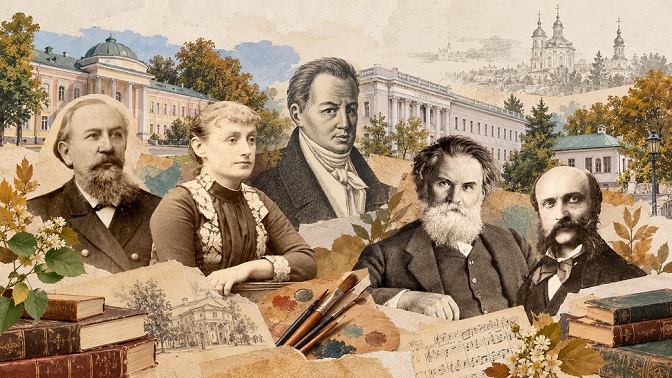
A decade and a half would pass, and on 3 June 1810 he was appointed to the post of chief supervisor (director) of the Poltava Home for the Education of Children of Impoverished Nobles. The most accurate information about this institution is contained in the article "The Home for the Poor", published in 1818 in the "Journal of the Philanthropic Society". The article was submitted by I. Kotliarevskyi. It states that the Poltava Home for the Education of Poor Nobles was founded by Prince O. Kurakin in 1805. The institution’s charter was drawn up by the renowned poet and public figure V. Kapnist. According to the regulations, the institution could admit not only the children of the nobility but also those of the lower ranks. Only 50 pupils could be supported at public expense. "Self-funded: (at their own expense) boarders were accepted without restriction. The final paragraph of the editorial stated that I. Kotliarevskyi was "known to lovers of our literature for his "Eneida", very skilfully translated into Ukrainian", and it was also emphasised that he had left military service solely to care for his elderly mother.
Ivan Kotliarevskyi was concerned both about his pupils’ appearance and their physical health, and set up a special hospital. Our poet was categorically opposed to the use of corporal punishment on children. He was able to recognise the positive qualities in children that needed to be nurtured. On his initiative, an amateur drama group was formed by the pupils, and in 1816 a full-scale costumed performance was staged. Alongside various extracurricular educational activities, it is worth noting I. Kotliarevskyi’s publication of the weekly handwritten magazine "Poltavska Muha" for the youth of Poltava, in which the main focus was on moral education.
Taras Shevchenko portrayed I. Kotliarevskyi as a humane, compassionate teacher in his novella "The Twins". Although this is a work of fiction, it was based on stories about Kotliarevskyi heard in Poltava in the mid-1840s, when Shevchenko was sketching the house of the author of the "Eneida". The words spoken by Shevchenko represent the highest praise for Ivan’s work as a teacher.
Today,
the Ivan Kotliarevskyi Museum-Estate in Poltava serves as a reminder of this chapter in the writer’s life, preserving the memory of his multifaceted activities — literary, civic and educational.
Famous artists — lecturers at educational institutions in Poltava
In the first half of the 19th century, new educational institutions opened in Poltava: the Institute for Noble Girls (1818), the Poltava Cadet Corps (1840) and private grammar schools, which helped attract new creative talent and experienced teachers to the city. One of them was the artist Ivan Zaitsev (1805–1890), who moved to Poltava with his family in 1848. A graduate of the St Petersburg Academy of Arts, from which he graduated with a silver medal and the title of ‘artist without class’, which entitled him to teach in educational institutions, he was appointed as a drawing teacher at the Poltava Cadet Corps. Ivan Zaitsev devoted over 40 years of his life to teaching. One of his pupils was Mykola Yaroshenko – who would later become an outstanding realist painter. Ivan Zaitsev was the author of the memoir "Memoirs of an Old Teacher" (1887), in which he left the only known account of Taras Shevchenko at Vasyl Shiriaiev’s studio in St Petersburg in the early 1830s.
One of Zaitsev’s younger colleagues was the artist Vasyl Volkov (1840–1907). After graduating from the St Petersburg Academy of Arts with the title of Class Artist of the Third Degree, Volkov came to Poltava in 1867 in search of a teaching post and found a second home there. Initially, he taught drawing at the Institute for Noble Girls, and from 1879 until the end of his life, at the Poltava Cadet Corps. In addition, he established his own private drawing studio, where he prepared pupils free of charge for admission to higher education institutions. Among his pupils was the future sculptor
Leonid Pozen, creator of
the monuments to Ivan Kotliarevskyi and
Mykola Gogol in Poltava.
Hryhorii Miasoiedov’s (1834–1911) drawing and painting studio, opened in 1894, was well known in Poltava. The work of Ivan Miasoiedov (1881–1953) had a significant influence on the Poltava artistic community. These art studios played an important role in the development of many Poltava artists, including Hryhorii Tsyss, Maria Buchheim, Solomon Rosenbaum, Vsevolod Maksymovych and others.
It is impossible to imagine cultural life and educational developments in Poltava during the first half of the 20th century without the figure of Oleksandra Roshchyna (1857–1941) – one of the city’s first professional female artists. In the summer of 1899, she arrived in Poltava, where she had been invited to take up the post of art teacher at the Institute for Noble Girls. She devoted over 40 years to teaching, working at various educational institutions in the city, including N. Starytska’s Girls’ Gymnasium, Secondary School No. 2, and art studios. Over the course of her career, Oleksandra Roshchyna enriched the educational sphere with her own teaching methods and the practical application of art programmes.
A significant event was the establishment of the Pedagogical Bureau under the Poltava Provincial Council, which was headed from 1917 to 1919 by the renowned educator, archaeologist and cultural figure Mykhailo Rudynskyi (1887–1958). He gathered around him a fairly strong circle of talented graphic artists who illustrated books for children and young people, as well as textbooks for Ukrainian schools. These publications were noted for the high quality of their illustrations and printing. Members of this circle included Dmytro Angelskyi, Yevhen Baluta, the brothers Ivan and Stepan Butnyk, the brothers Pavlo and Fedir Rozhankivskyi, Leonid Vekshtein and Anton Fedorenko.
In the mid-1920s, a vibrant artistic community of painters and graphic artists emerged in Poltava. Among them were Hryhorii Tsiss, Solomon Rosenbaum, Matvii Dontsov, Ivan Orlov, Pavlo Horobets, Viktor Magdenko, Anton Fedorenko, Dmytro Angelskyi and Leonid Vekshtein. They gathered around the Poltava Art Museum, organised art exhibitions in the city, and most of them taught at educational institutions and art studios, passing on their skills and knowledge to the next generation.
Thus, Poltava gradually transformed into a city where education developed in constant dialogue with literature, history and art – a dialogue that continues to this day within the walls of the
Mykola Yaroshenko Poltava Art Museum (Art Gallery).
Ivan Pavlovskyi — a teacher who brought history to life
Ivan Pavlovskyi is known primarily as a historian of the Poltava region, an archivist and the founder of the Museum of the Battle of Poltava at Shvedska Mohyla. An important aspect of his life was his work as a teacher, to which he devoted almost four decades.
After graduating from the Faculty of History and Philology at St Volodymyr’s University in Kyiv in 1874, Ivan Pavlovskyi began teaching history at the Petrovsky Poltava Cadet Corps. He worked there until 1913.
According to the recollections of his students, Ivan was a teacher who knew how to speak captivatingly about history and instil an interest in it. His lectures were always lively and engaging, accompanied by the display of engravings and drawings, including the use of a "magic lantern" – the prototype of the modern film projector. He involved the cadets in building up the museum’s collection, so as to familiarise them in practice with the process of collecting, studying and preserving historical materials, and to foster an interest in the past. Ivan Pavlovskyi sought to illustrate history through specific events, figures and documents, whilst his own research work enabled him to continually enrich the content of his lessons. The distinctive features of his teaching are also evident in a notebook containing records of the cadets’ marks. It was precisely because of Ivan Franzovich’s incredible professionalism and diligence that he was consistently elected as a member of the Cadet Corps’ teaching committee.
It is telling that the historian combined teaching with active public and educational activities. He was an organiser and participant in public readings and Sunday schools in the Poltava region.
For Ivan Pavlovskyi, education was inseparable from his other activities. As a history lecturer, educator, archivist and museum curator, these areas of his work complemented one another and shaped a distinctive approach to the preservation and dissemination of historical knowledge. His legacy lives on today at
the State Historical and Cultural Reserve "Field of the Battle of Poltava" , where the history of the Poltava region is preserved, researched and promoted, making it accessible to new generations.
Oleksandra Rudchenko – a teacher at the Poltava Institute for Noble Girls
Another important chapter in the history of education in Poltava is linked to Oleksandra Rudchenko — the wife of
Panas Myrnyi, a classic of Ukrainian literature.
In 1889, the writer Panas Rudchenko broke his vow never to marry – his heart had been captured by a young music teacher, Oleksandra Sheidemann. She was born on 16 November 1863 in the town of Karlivka in the Poltava Governorate. The Sheideman family was quite large – 17 children – but all of them received an education. Oleksandra, like her sisters, studied at the Poltava Institute for Young Ladies of Noble Birth.
At various times, well-known figures from the worlds of culture and literature worked here – Lev Borovykovskyi, Stepan Steblin-Kaminskyi, Hryhorii Markevych, Dmytro Pylchykov, Ivan Zaitsev, Vasyl Volkov and Feofania Bazylevych. Olexandra’s music teachers were Alois and Venceslav Jedlichki. In 1881, Olexandra received her school-leaving certificate.
Even whilst at the institute, Oleksandra had been passionate about music, so she enrolled at the Kharkiv Music College, graduating in 1887. With an excellent education in the humanities, the writer’s future wife returned to her institute, this time as a lecturer. The standards required of teachers at this institution were exceptionally high, extending far beyond mere subject knowledge. Moral qualities were also taken into account. Oleksandra taught music theory and piano from 1887 to 1889. In letters to his family, Panas mentioned that she worked there until 1891. Oleksandra was an exceptionally well-educated woman: she knew several foreign languages, loved literature and the theatre, ran a drama club for grammar school pupils and took an active part in the town’s community life.
Unfortunately, Oleksandra was forced to leave the institute. Firstly, she was unwell and needed rest. Secondly, the young couple were expecting their first child. So, by mutual agreement, Oleksandra gave up her teaching career to devote herself to her family. Her life was closely linked to Poltava’s cultural scene, and she herself has gone down in the city’s history not only as the wife of an outstanding writer, but also as an educated woman and teacher, fondly remembered at
the Panas Myrnyi Literary and Memorial Museum in Poltava.
Volodymyr Korolenko: education begins with respect for the individual
At the start of the 20th century, it is impossible to imagine a discussion of education in Poltava without mentioning Volodymyr Korolenko.
When Volodymyr decided in 1900 to move from St Petersburg to Poltava, he was extremely concerned about finding a good secondary school for his daughters, Sofiia and Nataliia. Korolenko regarded education as an essential component of a successful and fulfilling life. Here is what he wrote on the subject in a letter to the budding author Valentyn Sventsytskyi dated 15–16 September 1916: "And above all – study! Do not think that a writer does not need an education… A secondary school, then a university – these are the things that will, in any case, give you a great deal. Whether you will become a writer or an artist – it is impossible to say for certain at this stage. But you must, without fail, become an educated person. So, once again, study and study.”
The choice fell on the Mariinsky Girls’ Gymnasium (today, the building on
Krugla Square houses
the Poltava City School of Arts "Little Academy of Arts" named after Raisa Kyrychenko). The elder daughter was to start in the fifth year, the younger in the second.
After moving to Poltava, Korolenko immediately threw himself into public life, joining or even heading dozens of non-governmental organisations. The writer generally placed great hope in the activities of precisely such voluntary associations of people working together for the good of society. In the early 1900s, whilst his daughters were at school, Volodymyr chaired the parents’ committee at the aforementioned grammar school, taking a keen interest in all the issues facing the school. In addition, he chaired the committee of the town’s public library, supported the development of the cultural and educational environment, and, together with the "League for the Rescue of Children", took part in organising aid for homeless children and establishing a children’s home near Poltava.
In 1904, after graduating from the gymnasium with distinction (a gold medal), the writer’s eldest daughter, Sofiia Korolenko, went to work as a teacher in the village of Diomky in the Pyriatyn district of the Poltava province, of her own volition, to test herself in independent life, and worked there for one academic year (1904–1905). Volodymyr gave his daughter sound advice, particularly regarding the discipline of her pupils, and even travelled to this remote village himself to support her.
For Korolenko, education could not be reduced merely to the transmission of information. He saw its purpose in the development of a personality capable of empathising with others, thinking independently and standing up to injustice. That is precisely why his literary and public activities can also be regarded as a unique form of social education.
Volodymyr Korolenko’s pedagogical and educational views, and his focus on the issues of childhood, education, human dignity and moral responsibility, remain an important part of Poltava’s cultural heritage. Today, the memory of the writer, public figure and humanist is preserved by
the V. G. Korolenko Literary and Memorial Museum in Poltava — a space where one can not only learn more about his life and work, but also reflect on the ideas he left for future generations.
Poltava’s educational history is not merely the history of its educational institutions. It is, above all, the story of people who invested far more in the concept of "teaching" than simply the transfer of knowledge.
Today, this tradition is carried on by teachers, lecturers, educators, club leaders, and staff at Poltava’s arts and extracurricular institutions. It is they who, day in, day out, help children discover the world, preserve cultural memory and, at the same time, shape the future.